Monday, December 22, 2008

Snowmen


Lila and her friend Cedar were making snowmen today, when a passer by stopped to take a picture. He uploaded it to the PI's photo blog.

Friday, December 19, 2008

10 Years of Christmas Crafts

Every Christmas, we make presents for our family and special friends. That's right - we MAKE presents. Molly and I were trying to remember all the things we made in the last 10 years - here is what we have come up with. I'll see if I can get pictures.

2008 - Felt Christmas ornaments
This year we will be giving out Ornaments for your tree felted with care in our kitchen.

2007 - I can't remember

2006 - Hmm, did we do anything this year?

2005 - "Home Made" music CD
This was an actual CD with music performed by each of us, solo and in various ensembles.

2004 - Lightswitch plates
We took plastic switchplates from the hardware store, and decopaged them with all sorts of things. One of my favorites was the Ant & Bee set!

2003 - Masks
Paper mache maskes, molded on our own (and friends) faces! My parents called this one "wierd!"

2002 - Decopage Chinese Takeout boxes with Cheese Biscuits
We had to let the glue dry long enough so the fumes would not infiltrate the cookies. Also, Molly made some gorgeous pillows this year.

2001 - Picture Frames
Picture frames made out of boxes and other sundry items, containing pictures of the kids when they were still cute. This was one of our earlier decopage attempts.

2000 - Straw Ornaments
We took bynches of straw and formed them into Christmas ornaments.

1999 - Paper Stars
This is the earliest Christmas craft that I can remember. We took colored wak paper and folded them into complex star shapes. A lot of work!

Thursday, December 11, 2008

Separating "real" from "secondary" market forces

We worship an idealized market. And yet, in real life it proves to be a fickle god. Like Zeus it throws thunderbolts at hapless earthlings on a whim. But looking closer, can we determine what portion of price movement are due to fundamental supply and demand issues, and what portion is due to the actions of all the secondary participants?

Is this possible, anyone?

Today's New York Times (read the story here) points out that demand for oil is down this year - the first time since 1983. It would be interesting to correllate the actual demand/consumption of oil with its price. If we did so then we could quantify the effect of real demand on the price of oil - whatever is left over must be due to secondary "market" forces (e.g. speculation).

Wednesday, December 10, 2008

Another argument for Local Market Economies

I like this article by David Korten in this month's Yes magazine. He is taking about how to create a sustainable economy. I haven't read the whole thing yet, but this quote caught my eye:
Smith envisioned a world of local market economies populated by small entrepreneurs, artisans, and family farmers with strong community roots engaged in producing and exchanging goods and services to meet the needs of themselves and their neighbors. His vision bears little resemblance to the Wall Street economy of footloose global capital, credit default swaps, reckless speculation, and global corporate empires.

Thursday, December 4, 2008

Rising Yields and Nutrition

It is no secret that agriculture has achieved increasing yields over the last century. Several techniques have been used, from hybridization, to denser plantings, to liberal use of petroleum based fertilizer. And others.

The Organic Center recently sponsored some research in which they studied the level of nutrition in staple foods as it related to these increasing yields. Their conclusion: while the yields of corn, wheat, and others increased, the nutritional value of the crops have generally decreased.

Here is a quote:
But American agriculture’s single-minded focus
on increasing yields over the last half-century
created a blind spot where incremental erosion in
the nutritional quality of our food has occurred.
This erosion, modest in some crops but significant
in others for some nutrients, has gone largely
unnoticed by scientists, farmers, government and
consumers.
Read the entire report (small pdf) from the The Organic Center.

Wednesday, December 3, 2008

Against the Grain

I am stuck in the airport today. Luckily I have a copy of "Against the Grain" to read. This book was written by Richard Manning. He has been laying a case as to how the activity of agriculture has hijacked civilization. It is a good read.

One of the points he covers is that of subsidized agriculture in the United States. We all know that agriculture is heavily subsidized, and I for one used to think that this was an unfortunate necessity to preserve the way of life of American farmers. However, it is clear that the life of the american farmer is already unrecognizable from how it was 30, 40, 50 years ago. Modern corporate agriculture, the chief beneficiary of the subsidies, has displaced the self-sufficient, independant, clear thinking farmer.

Agriculture is not a closed system. It requires many inputs from the outside, mostly in the form of fertilizer. The fertilizer contains nitrogen, which helps to channel the crop's energy to producing big, ripe fruit. There used to be a problem when fruit got too big. In the case of wheat, it would get so big that the stem could not support it, so farmers had to moderate their application of manure and other nitrogen fertilizers. This problem has been mitigated by hybridization of wheat to product plants with smaller, stockier stems, that won't fall over.

The runoff from all this fertilizer is causing huge problems in our waterways. There is a part of the Gulf of Mexico called the "Dead Zone" - a place where nothing lives - that is caused by excess nitrogen in the water.

Farms used to include livestock, the manure of which would be used to fertilize the crops. In addition, some of the crop was saved each year for seed. Also, farms used to grow several crops, which would be rotated to preserve the nutrients in the soil. According to Manning, this has all changed. Seed is purchased each year from the big Ag companies - (e.g. Archer Daniels Midland, Monsanto). Fertilizer, produced from petroleum, is likewise purchased from outside. Crop rotations are not necessary as chemical applications can replenish the soil nutrients. Furthermore, government paychecks are super important to the farmer. He knows he can count on them when a crop fails, so he has an incentive to plant on poor land - he'll get payed anyway.

Monday, October 27, 2008

News Flash: Economic Activity Unsustainable

Michael Mandel at Business Week wrote a great article about the current economic crisis. The article is entitled It's Not a Crisis of Confidence. Here is a quote:

The real problem with the economy is that long accepted patterns of cross-border technology transfer, trade, and finance are simply unsustainable.

Thursday, October 23, 2008

The Limits of Self Interest

Alan Greenspan testified today about the credit crises. From the Reuters story there is one telling quote:
"Those of us who have looked to the self-interest of lending institutions to protect shareholder's equity (myself especially) are in a state of shocked disbelief."
So, the next time a policy maker chides you with the "let the market decide" mantra, take a deep breath, remember that self-interest and markets are super effective for determining some things, but they are not always right. Even Greenspan admits that.

Monday, October 20, 2008

Driveway Rehab

I called around last week asking for bids on cutting up a 30x12 foot concrete part of my driveway. We have plans to turn this area into gardens, and concrete just won't do. I called around for prices, and the cheapest I could get anyone to quote me was $600.

That's a lot of money for me, so after consulting with some friends, I decided to do this job myself. Some of the concrete came up easily. I would just stick a pry bar underneath, apply pressure to force it up, and then whack with a sledgehammer to break into smaller pieces. Eventually we plan to use these pieces for raised beds and footpaths. But I bet we will have plenty, so if you need some concrete, I would be happy to drop some off on your doorstep.

It is quite satisfying work, really, and afterward my muscles ached in a way that reminded me of a good days work. It is a feeling that doesn't come often from my "day job" as a software engineer. I thought the whole job would take me a day, but after about 8 hours of work I have gotten only a third up.

So, while I am grateful for the time I spent prying, heaving, and bending in the dirt, I am a bit vexed that I wasn't wasn't able to cut a deal with someone who might be better at it than I.

Six hundred dollars is a substantial sum of money, more than I was willing to pay. Why? Because I have a fixed supply of money coming in each month, and that supply just barely meets the demands of our household. There is no room in the budget for an unplanned $600 expense.

And yet, it took me 8 hours to get a third of the job done. Assuming that I improve some, I could get the rest of the job done in 12 hours. That's 20 hours total, meaning that for every hour I work, I save myself $30.

Looking at it another way, I earn $30 per hour for my labor moving concrete.

The guys I spoke with on the phone said they would get the job done with a crew of two guys in 6 hours. That's 12 hours total, or about $50 per hour.

Hmmm....

On the Rootfop

My neighbor Sjell was kind enough to come over and help fix a leak in my roof today. While we were up there we had one of those classic Seattle moments, when the sun finally breaks out of the clouds just before setting, and lights up everything with a golden glow.

So, I got my camera and took some pictures. Later I stitched them together into a single panaroma with a handy program called autostitch. Posted by Picasa

Monday, October 13, 2008

Derivative Regulation Contest Entry

Its looking like one of the most certain things to come out of this financial crisis is more regulation. I have spent a fair amount of time imagining how derivatives would be regulated.

Looking at the extremes, "outlawing" derivatives seems reasonable to consider. Assuming that this is enforceable, it would surely meet with lots of resistance from Wall Street. Discredited as it is, Wall Street still has most of the money, and most of the ears of our representatives.

It is my impression that laws like this often don't work. Companies have incentives to find ways to get around them, and will do so, just like people find ways around other prohibited, but attractive, activities. And there are all sorts of things that derivatives can provide that are useful in certain situations. If they are banished outright, I could imagine an underground economy that trades them.

Here is another idea.

The government could require that all financial companies publish their coefficients of risk. This data would be made available by the banks, to the government, daily. Since this is in the public trust, the numbers would have to be available publicly. That is, the banks would make public heretofore private information.

A consortium would be formed that would
  1. choose a risk model
  2. determine the important attributes and measurements to be reported
  3. create a "reference implementation" that measures, calculates, stores, and publishes the risk data of the banks. In addition suites of acceptance tests that would validate other implementations
  4. create another reference implementation that collates the daily data as reported from all the banks, and plugs it in to a meta-risk model that balances the risk of the banks together
  5. choose limits on acceptible values for the bank's reported risk coefficients. This would include values derived from the data of a single bank. If a bank reported values that violated thes ranges, then the bank would suffer a penalty of some sort. The penalty should be substantial (such as losing management control) to discourage risky behavior.

The software would be freely available in source code form. All interfaces would be public. Thse data would be freely available via web services, hosted by the federal government. Anyone could read the interface documentation and create a web application.

Open source, open data, this makes sense since it is a public risk that is being regulated, like levels of Carbon emissions. Encourage other countries to use the software and contribute to its development.

A high profile government sponsored open source software project of this magnitude and this importance would attract the best minds in the country. Just in case the open source development model does not work for getting the project done, though, the government could also solicit bids for alternate implementations. Several companies could be hired to implement the project. There could even be a contest to create the best implementation.

In fact the whole project could be a contest. Offer a million dollar prize to the best proposal for a system to essentially manage the risk of the nations financial system.


So here's my entry.

Friday, September 19, 2008

Thumbs up on the tea-tree oil, dad!


There was a lice outbreak at school this week. I don't want to nit-pick, but I was one of the parents who was called in to take my child home.

On the way home from school, we stopped at the Herbalist, an apothecary in the northeast part of town (I think it's Ravenna, but maybe Wedgewood). Along with Tea Tree shampoo, I picked up a bottle of hair oil - jojoba and almond infused with rosemary, lavender, tea-tree, bay, and sage. It is wonderful stuff.

We did a "treatment" at home, which consisted of soaking her hair in the oil overnight, washing thoroughly in the morning, and then about 1 hour of combing and seeking, seeking and combing. I didn't find anything, and was even wondering (nay, suspecting) that the staff at school had made a mistake.

This morning we went to school, and D. from the office found 6 nits. I didn't remember them being THAT small! They were tiny, but unlike the random other specs in there, these were unmistakeably attached to a hair. I was a little embarrassed that I had not found them myself. D. showed me how to do it, and now I know, and will try to remember this time.

Wednesday, September 17, 2008

With Apologies to Bremerton

Remember the "new economy"? More importantly, do you remember when that notion of ever-increasing equity prices was kicked in the nuts by reality in the dot-com bust? Yeah, I forgot about that one too.

But I recognize the feeling, the "something doesn't feel quite right" feeling that I had as real-estate prices soared in the first half of this decade. The easy home-equity credit that we landed allowed us to put a new kitchen our 4 bedroom Seattle fixer, rather than move to Bremerton for something equivalent (for those who don't know, Bremerton is the Newark of the Pacific Northwest). It also apparently fueled demand for houses, condos, co-ops, and coops, pushing up prices.

That something ain't quite right feeling is getting some reinforcement today, with the Fed's bailout of AIG, the bankruptcy of Shearson ... er... Lehman, and the sale of Merrill Lynch to BofA. The market down 1000 or so points in two days. Pretty grim. One of the grimmest that I recall.

Several notable recessions were preceded by prolonged periods of easy credit, leading to euphoria in the financial markets, and ended by sudden and sever downturns. The 1873 recession, the great depression, for example. We should have recognized it again this time, but it is soo hard to see the unpleasant truths when everything is going up up up!

Apparently, sub prime mortgages started to have delinquency problems in early 2005, about the same time that home prices started to taper off. Funny, the stock market did not register much of a response to this until 2007, two years later. At that time, a small number of financial institutions halted redemptions in their funds because they were having difficulty valuing the complex fund assets.

These complex assets, or structured finance products, were originally thought to mitigate risk. I remember as an options trader, making markets for counter parties who were seeking to offset some underlying risk in their portfolio with straight-up currency options. It worked for them. However, while options are complex and difficult to value, the "structured" instruments issued against pools of mortgages were way more complicated.

At the time they were issued, they seemed great. So great that their inherent risks seemed nonexistant. So great that having them on your balance sheet was as good as cash or government bonds. So great that Moodys and Standard & Poors might give you a triple-A-plus.

But, once the underlying asset went down (e.g. the steady stream of mortgage payments), so too these asset tanked.

In retrospect now I think that all the inflation we have seen in the last few years - oil, food, concrete - was fueled not by China's insatiable demand, but rather by an excess of money. An excess of money fueled by super-easy credit, and secured by the ability of regular Joes to make mortgages payments on houses with crazy prices.

I hope that all the regular Joes out there are doing OK. It's not their fault. I don't even think its the government's fault, or the banks fault. It's a phenomena.

And, as Einstein said... er, well, read the previous post.

Note: I leaned heavily on the BIS 78th Annual Report for this post.

Monday, September 15, 2008

Great Einstein Quote

No problem can be solved from the same level of consciousness that created it.

Tuesday, September 9, 2008

Scraponomics

My '91 Jeep Cherokee is stuck in reverse. The clutch has been giving me problems for a while - I really should have brought it in a few weeks ago. But, I didn't, and on Saturday I shifted into reverse, and it never came back out.

Anyway, tonight I called a tow-er, and he came by with his big, noisy diesel rig. With some help from my neighbor, we pushed the jeep up into onto the bed. Then I jumped into the cab and we headed on down to the clutch shop.

On the way there we talked about various things. He works for a scrap yard by day, and by night he tows cars to earn some extra cash. I told him that I had just sold my son's wrecked Lebaron, and was surprised at how many people called who were interested in scrapping it.

"Hell yeah" he said. "Why this jeep of yours would have been worth $700 at the scrap yard a few months ago. That's just for the steel - the catalytic converter and the aluminum hubs would have added another $300"

Wow! I only paid $2000 a few years ago for this jeep. My loss from depreciation is theoretically maxed out at 50%, as long as the market for raw materials holds.

Turns out that the scrap market has plummeted in the last few months. The reason? The recently completed 2008 Olympic Games in Beijing. Japan (maybe he meant China) apparently is the primary purchaser of scrap metal from Washington to Montana, and they stopped all the steel mill activity prior to the Olympics in order to clear the air a bit. With the chief buyer out of the market, prices have plummetted.

Wednesday, September 3, 2008

Ultralight Backpacking

Some years ago I was attending the closing potluck for my then 10-year-old son's wilderness camp. The camp was put on by Wilderness Awareness school in Duvall, WA. If I understand correctly, this school is an offshoot of the work of Tom Brown, author of The Tracker and other books. If you have read Tom's works, you know that as a youth he was educated by an Apache elder in the ways of the wilderness.

Anyway, on this particular occasion I was picking up my son after a week of learning wilderness skills. There was a potluck, and I took the chance to talk to one of the instructors. We chatted a bit about the camp, the program, the beauty of the wilderness, etc. Wishing to show that I had some experience in the wilderness, I fondly recalled (out loud) my experiences backpacking on the East Coast and British Columbia. After a few moments I paused.

There was a curious look on the counsellors face. He must have been about 15 years younger than me, but his next comment showed who was the wiser. "Yeah, I used to backpack a lot myself" he said. "Eventually I came to realize that all I was doing was carrying the world around in my pack. So I ditched it."

"Oh, so you've stopped camping" I asked?

"Oh no, I still go camping. All the time. But now I leave the backpack at home, where it can't get between me and the wilderness. I build shelter when I need it, and forage for food."

Wow, did I feel like a chump.

Still do, actually. I love the wilderness. I love nature. I have loved it ever since I was a kid, when I used to spend hours in the woods near our house. Huck Finn was my childhood hero - I used to dream of living in caves and makeshift shelters on river banks just like Huck.

In fact, I secretly vowed that some day I would retake my youthful dreams and make a trip to the wilderness with nothing but my clothes, and see how I would survive.

Well, a more practical version of that dream came a little closer to realization tonight, thanks to a story about "Ultralight Backpacking." In this story the author tells how one hike for days on end in the wilderness with nothing but a small pack that weighs a total of 15 pounds. Sounds great - I'll let you know when I do it!

Tuesday, August 26, 2008

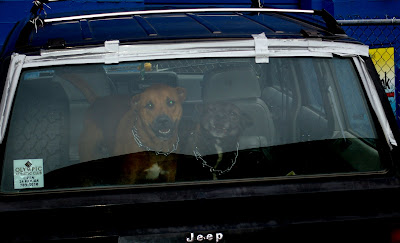
Today, like many days that I drive to work, I had to pause at Safeco Field as the commuter train passed by. In the back seat my two dogs Tula and Sweety shared the experience of waiting for the train. I turned off the engine and tried to look inside the windows of the passing Dining, Sleeping, and Coach cars. Silouettes of people standing up and stretching reminded me of similar moments when I was inside the train myself.

I had to leave Tula and Sweety in the back of my jeep, while I went in to write code at work. I think that Tula and Sweety do not mind. They are always happy to see me come back to the car, which I do a few times during the day to take them on a walk.


Sunday, August 24, 2008

Miracle on NW 79th Street

There was a beautiful display last Sunday in the early evening. There had been a rainstorm, and just before the sun set, a magnificent double rainbow appeared. Even more amazing, you can see from this photo that it actually sprouts from the steeple at St. John's catholic church up the street!
Posted by Picasa

Awesome Display of Chinese Dominance


While I didn't see the opening ceremonies of the Olympics this summer, I did hear a lot about them. I guess they were quite a spectacle. While one friend called them "terrifying", others were less impressed, observing that one could do a lot with $50 mil.

Anyway, the chatter reminded me of an image I had seen before, of the Chinese putting on a great display of uniformity and cooperation that was surely just as powerful in its day, and definitely did not cost $50 mil. I hunted for the image, and eventually found it in Arthur Toynbee's great work "A Study of History" - this is the 1 volume version with lots of pictures, not the 12 volume unabridged version.

Here is the caption:
The new society? Athletic display in Modern China: Westerners tend to see in China a repulsive modern Leviathan, but behind the ceremonial lies an ideal of mutual solidarity and co-operation from which a fragmented world may learn.

Saturday, August 16, 2008

Rainbarrel PSI Issues

There are some things I need to know about how water is used. Like, how much pressure (PSI) is needed to run sprinklers, appliances, faucets, etc. Also, what are some valid techniques for achieving that pressure. For example, if I put my 55 gallon rainbarrel on a tree stump, will I be able to run a sprinkler?

I found a helpful article at http://www.howstuffworks.com/water.htm, and I learned this:
  • Each foot of height provides 0.43 PSI (pounds per square Inch) of pressure
  • A typical municipal water supply runs at between 50 and 100 PSI
  • Major appliances require at least 20 to 30 PSI
That means I would need a 45 foot tree stump!

Saturday, August 9, 2008


It is the middle of summer here now, and as usual it has been quite dry. It happened to rain pretty hard today, however, overflowing my 55 gallon rain barrel quickly.

My wife and I are in the process of turning our home in Seattle into a sustainable urban homestead. I decided this morning that I would document this process in my blog. You can expect to see pictures, plans, and hopefully some progress over the coming months.

In Seattle we do receive an awful lot of water from the sky. However, there are a few months in the summer when it is very hot and sunny. People water their lawns, their gardens, etc. A full rain barrel can easily be depleted within a few days if used as a primary watering source.

Water from the city ain't cheap, so I would like to use this rainwater during the dry months. But how to store, how to collect, these are questions that must be answered.

Wednesday, May 14, 2008

am i imified?


This is the coolest little app I hafe found in a while - it allows me to post to blogs, delicious, etc. from my google-talk app. No longer do I have to log on to blogger or whatever when I find somethjgin I want to save - I can just IM it!

Thursday, February 28, 2008

On the way to school yesterday, my daughter and I noticed a big crane sitting in front of a house. Today, the crane was still there, but the house was gone.

"Look Daddy, the house is gone. Why did they do that?"
"I think they knocked down the house so they could build apartments."

My daughter paused for a second, thoughtful. And then she spoke her thoughts about the whole business.

"That's mean."

Wednesday, February 6, 2008

In this weekend's NY Times Magazine, Andrew Rice has told a "cautionary tale of well-intentioned development." The subject is Uganda, and its beloved Ankole cow, whose existence is coming under threat by breeds imported from the west.

For centuries the nomadic people of Uganda have lived closely with the Ankole in a "tight symbiotic embrace." This beautiful longhorn holds a cherished place in the hearts and minds of all Ugandans. The cow is part of the living landscape of Uganda.

The Ankole has developed into a hardy breed in order to survive the difficult climate in Uganda. One Ankole can produce about 1/2 gallon of milk per day. A Holstein cow, common in the US and Europe, is less hardy, but can produce up to 6 gallons per day.

Apparently it has become possible to import Holsteins into Uganda. Even though these cows are much less suited to the environment, and require more medicine and care, their milk producing capacity presents an economic opportunity to local farmers that possibly justifies these extra cost. The result? Many farmers are incorporating Holsteins into their herds.

When I read this article, I wondered to myself at the possibility of increasing he milk production of Uganda 12-fold, which would happen if each Ankole were replaced with a Holstein. What would the people of Uganda do with all that milk?

The article points out that there have been some problems with just this issue - there is not an adequate infrastructure to transport and store the milk, so much of it spoils. It also mentions that "international organizations realize that increased productivity means little if it’s not accompanied by market growth", so USAID is spending a lot of money promoting milk among Africans.

Apparently the marketing program has not been a huge success. According to a USAID spokesman, “a lot of consumers don’t understand how important milk is.”

Its a familiar story. "Poor" people trade cultural riches for "economic benefits." It seems inexorable but tragic. We know it because we have lived it ourselves. We've chosen cheap, mass-produced, imported and disposable over goods made by local craftsmen. Sure, our craftsmen are gone, but look how we have benefited, right?

So, Ugandans, I read the story about your Ankore, and I wish that you would keep that beautiful cow, and forget the Holsteins. However, because I am a westerner, and have sacrificed my own Ankores, I cannot reasonably ask you to do the same. I cannot ask you to do what I myself have not done.

These days, there are lots of stories like this one. Perhaps one day all the old things cherished by people will be gone, and then all these stories will be gone too. But that's another story.